How to organize small business receipts in Canada for tax time
Tax time doesn’t have to be stressful.
The simplest way to organize business receipts is to capture each one as soon as you receive it, store everything in one consistent system and review your records monthly.
Keep paper, emailed, downloaded and missing receipts from piling up in temporary places where they can be forgotten.
In my experience, one of the most stressful parts of getting ready to file taxes is gathering all the necessary documentation.
When your business has dozens or hundreds of transactions each month, it’s easy to lose track of the corresponding receipts—especially when some are on paper, others are buried in your inbox and still more are sitting in online accounts.
Luckily, you don’t need an elaborate system to keep them organized.
In this post, I’m going to show you a simple way to handle each receipt once, keep your records current and avoid a last-minute search at tax time.
Why do we save receipts?
Receipts help support the business expenses you claim.
Without adequate records, an expense could be disallowed if the Canada Revenue Agency (CRA) reviews your return.
Missing expenses work against you too: if you forget to record legitimate business expenses, you could end up claiming less than you’re entitled to. Both mistakes can cost you real money.
Receipts also help show where your money is going, how much you’re spending and how often.
You can use that information to make better business decisions—not only about where your money goes, but about how you spend your working days and, ultimately, your life.
What information must a business receipt include?
Let’s start with what makes a receipt a receipt in the eyes of the CRA.
The CRA says business receipts must include the following:
Purchase date
Seller or supplier’s name and address
Buyer’s name and address
Full description of the goods or services
Supplier’s business number if the supplier is registered for GST/HST and the purchase price is $100 or more before tax
What if the receipt is missing information?
The receipt should describe what you purchased. If it doesn’t, write the description on the receipt. We know that’s probably not possible on a little strip of paper. In that case, record the description in an expense journal.
Example: The receipt doesn’t describe the purchase
| Date paid | Seller or supplier | Description you added | Total paid | GST/HST | Amount before tax | Expense category |
|---|---|---|---|---|---|---|
| July 8, 2026 | Example Office Supply | Pens and mailing labels | $22.60 | $2.60 | $20.00 | Office supplies |
And if you weren’t given a receipt at all?
Use the journal to record:
Seller or supplier’s name and address
Total amount paid
Payment date
Details of the transaction
GST/HST paid, if you have documentation showing the amount
Expense category
Example: You weren’t given a receipt
| Date paid | Seller or supplier | Address | What was purchased | Total paid | GST/HST | Amount before tax | Expense category |
|---|---|---|---|---|---|---|---|
| July 10, 2026 | Example Print Shop | 123 King St. W., Toronto, ON | 100 business cards | $56.00 | Not documented | Not determined | Advertising |
Don’t estimate the GST/HST. If you don’t have documentation showing how much tax was charged, record that it is unknown and ask the seller or supplier for a replacement receipt.
You can also check out the CRA’s example of an expense journal.
How long should you keep business receipts in Canada?
The CRA generally requires businesses to keep records and supporting documents for six years from the end of the last tax year they relate to.
Different periods can apply in some circumstances, including late-filed returns, objections and appeals, and records involving certain long-term property.
You can read the CRA’s complete record-retention rule.
Can you keep receipts digitally?
Yes, but with stipulations.
The CRA accepts records kept in paper form, electronically or as accessible and readable electronic images.
But just taking a pic with your phone does not necessarily mean you can destroy the paper original.
The CRA says an electronic image must:
Accurately reproduce the paper document
Contain the same information
Keep all significant details visible
The CRA also points businesses to additional imaging standards. If you aren’t certain that your process meets the requirements, keep the paper original.
You can read more about the CRA’s requirements for imaging paper records.
A time-saving system for organizing your business receipts
The secret to this time-saving system is a simple rule: when you get a receipt, put it in the place where it will be stored and processed.
That means not shoving printed receipts into your wallet or bag as you leave the store.
I used to do this all the time, and after a week or two I’d find a nest of crumpled paper at the bottom of my bag, each receipt too creased and faded to read.
The same goes for emailed receipts. Letting weeks or months of receipts and confirmations pile up in your inbox is just the digital version of that crumpled-paper nest.
Here are 5 ways to keep your receipts organized:
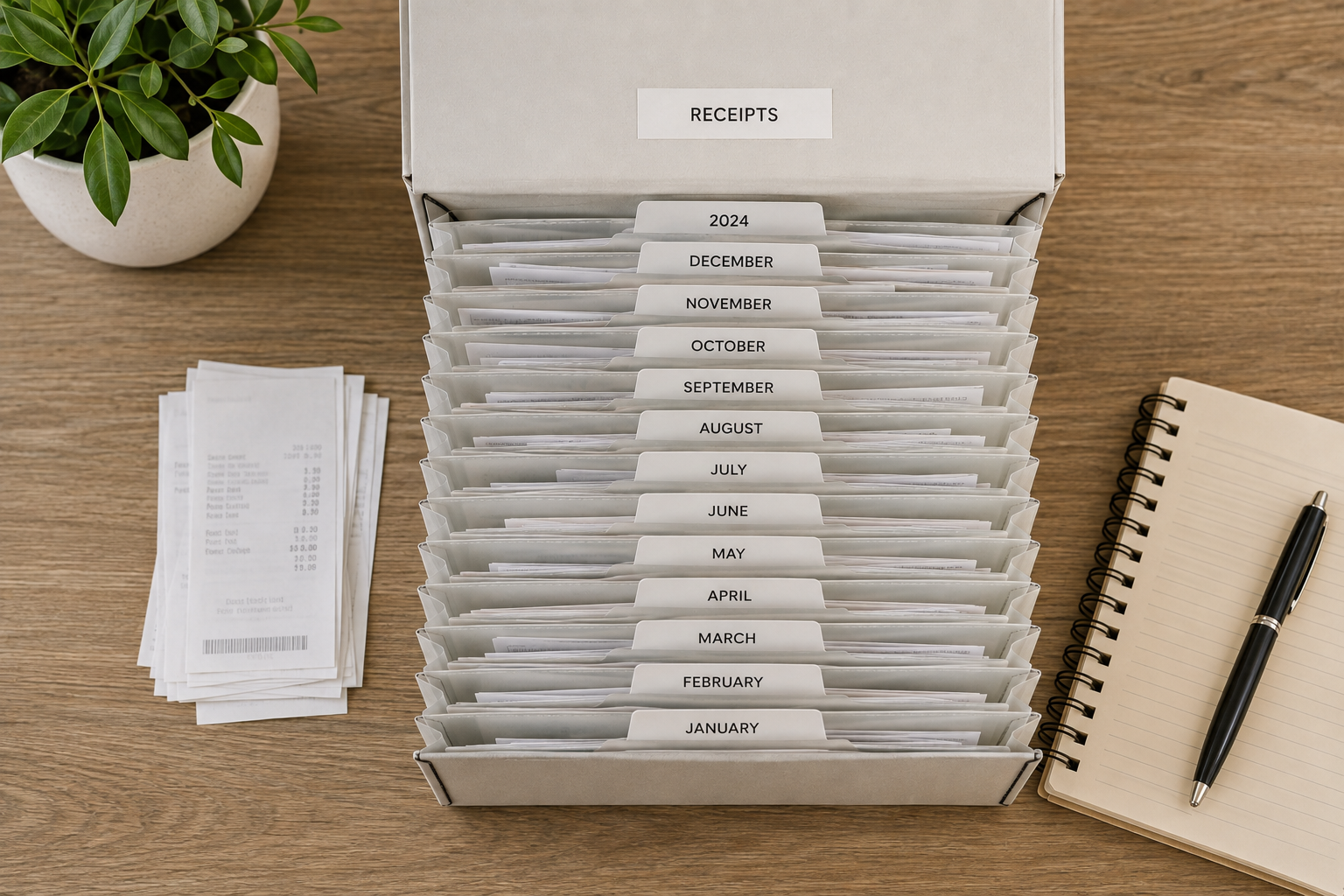
Paper receipts: Capture them immediately, then place the originals in one designated envelope or box.
Emailed receipts: Forward them directly to your bookkeeping system or move them into one dedicated email folder.
Receipts in vendor accounts: Download and upload them when you make the purchase instead of assuming you’ll return later.
Receipts sent by text or app: Save or upload them immediately; don’t leave them buried in your messages or notifications.
Missing receipts: Record the transaction in your expense journal and ask the supplier for a replacement.
Review your receipts at least once a month
Pick a recurring day, say, the fourth Friday of every month.
Then, set aside 20–30 minutes to review your receipts:
Check that every receipt is legible, stored in the right place and matched to the correct transaction.
Add any missing descriptions, note what the purchase was for and follow up on receipts you still need.
Look out for any duplicate charges, refunds that haven’t come through and business expenses you may have forgotten to record.
Doing this monthly keeps the details fresh enough to categorize expenses accurately. It also prevents a few missing receipts from turning into hours of detective work at tax time.
Make receipt organization part of the transaction
The goal isn’t to spend more time organizing receipts. It’s to stop receipts from becoming a whole other job in the first place.
Whether a receipt arrives on paper, by email or through an online account, put it into your system while the transaction is still fresh in your mind.
Then use your monthly review to catch anything that slipped through.
A few seconds now can save you from sorting through a year’s worth of receipts at tax time.
Want to spend less time sorting receipts and recording transactions?
Keep your books current with a fixed-price monthly bookkeeping package—month to month, cancel any time before your next billing date.