How to record business expenses paid personally as a sole proprietor in Canada
If you're a sole proprietor in Canada and you pay a business expense with your personal money, you still need to record that expense in your business records.
Using your own money to cover business expenses is common, especially when you're starting out. Those expenses can add up quickly.
The good news is that if the expense qualifies for a deduction, it can reduce the net business income on which you pay tax.
But first, you’re going to need to get the expense into your business records. This post is going to walk you through how to record such expenses.
Keep reading to learn:
What makes an expense a business expense
What records to keep
How to enter the transaction in your books
Whether you need to transfer the money back to yourself
How GST/HST may affect the entry
We’ll also cover the difference between current and capital expenses. That distinction affects how you record the purchase.
If you're a sole proprietor in Canada and you pay a business expense with your personal money, you still need to record the business expense in your books.
What is a sole proprietor and why does it matter?
Let’s start with defining what a sole proprietor is:
A sole proprietorship does not have a legal status separate from its owner.
You report the business’s income or loss on your personal income tax return and pay personal income tax on its net income.
Why does this matter?
It matters because while the payment may not appear in your business bank account or credit card, it still needs to be recorded in your business records.
When is an expense considered a business expense?
Let’s work through a common start-up expense: website hosting.
Say you’re a glass artist when you’re not teaching Grade 9 science. Although it’s just a hobby, your friends keep asking whether they can buy the miniature frog figurines you make from glass.
You give a few away. But then your friends’ friends see them and want those cute glass frogs of their own.
Hmmm, you think, maybe there’s a business here.
So you decide to build a website where people can see and order your glass frog figurines.
But because you haven’t opened a business bank account or credit card yet, you pay for the website hosting with your personal credit card.
The Canada Revenue Agency (CRA) says that a business expense is a cost you incur for the sole purpose of earning business income.
So, what matters is: Why you bought it, and how you use it.
When you bought the website hosting, you bought it so potential customers could see and order the glass frogs you’re selling.
The hosting therefore has a clear connection to earning business income.
Two other things you know about these expenses:
Only the business portion of an expense can be deducted. So if you also used the website for a personal project, like sharing personal photos of you lounging on Tereia Beach last summer in Bora Bora, you’re going to need to separate the expense into business (glass frogs) and personal (Bora Bora) portions using a reasonable method.
The timing of when a business begins can matter when determining whether an expense is deductible. The exact date a business begins depends on the circumstances. Unfortunately, daydreaming about selling your glass frog figurines is not the same thing as carrying on a business. Taking concrete steps to offer the frogs for sale may indicate that the business has begun.
What records should you keep?
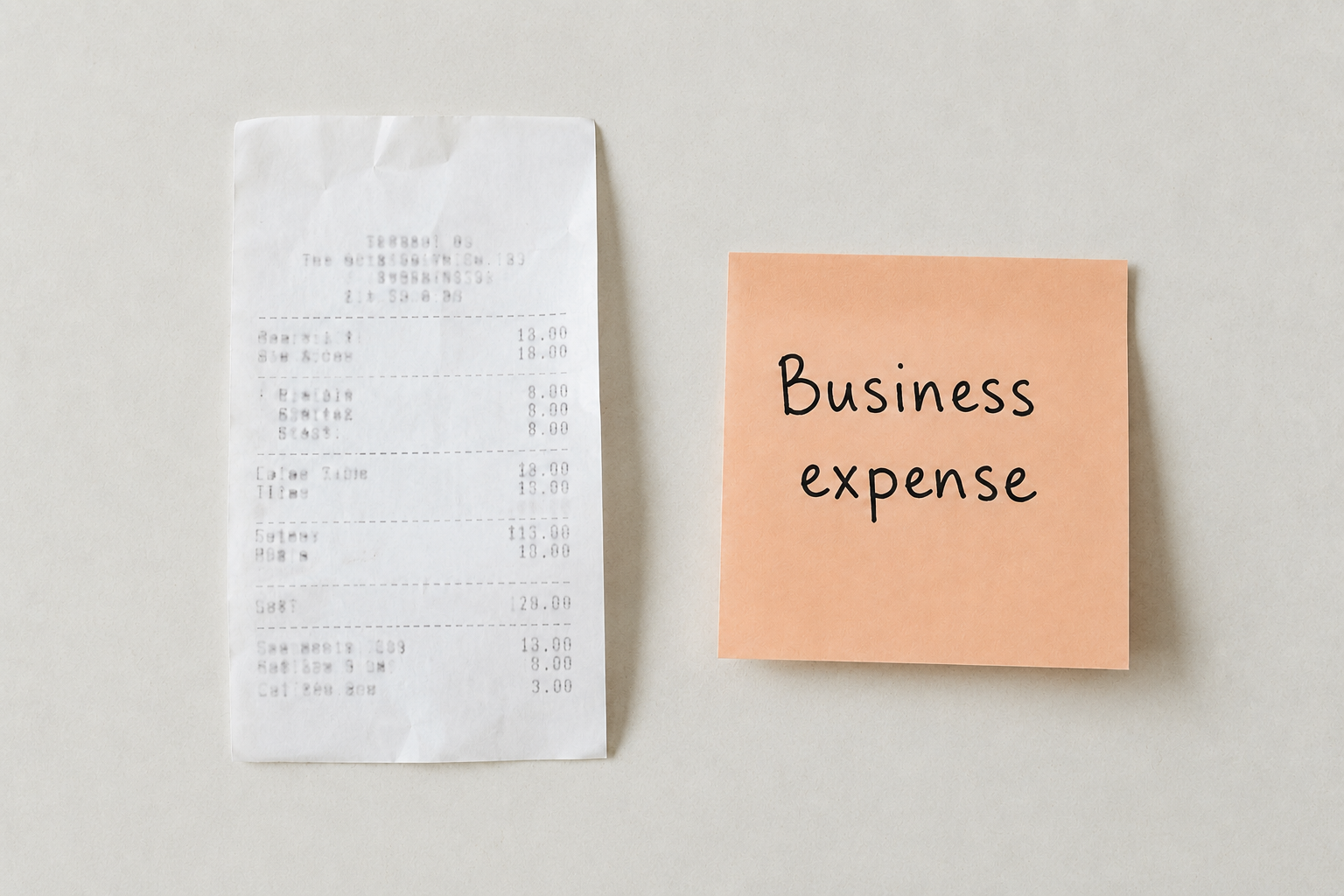
Pro tip: Always keep the receipt, invoice or other document that shows what you purchased.
So for purchases, and continuing with the website-hosting example, keep:
The invoice or receipt from the hosting provider
The date of the purchase
A description of the hosting service
The amount before tax
Any GST/HST charged
The vendor’s name and required identifying information
The payment confirmation or relevant personal credit-card statement
A note explaining that the hosting was purchased for the glass frog figurine business
The invoice backs up what you purchased and your credit card statement shows that you paid for it.
Important note: because a credit card statement usually will not contain all the information to support the expense, keep both the invoice and the credit card statement.
Also, the CRA says business expense receipts should show:
The date
The seller’s name and address
The buyer’s name and address
A full description of the goods or services
The vendor’s business number if the vendor is registered for GST/HST and the purchase is $100 or more before tax
No description on the receipt?
Add a description to the receipt or expense journal.
No receipt at all?
CRA says you can record the transaction in your expense journal and be sure to include the:
Vendor’s name and address
Amount paid
Payment date
Details of the transaction
And get a replacement receipt if possible.
Don’t make entering receiptless expenses in your expense journal a routine substitute for getting proper receipts.
Also, keep your receipts and other supporting records for six years from the end of the last tax year they relate to.
How to record an expense you paid personally
The expense needs to be entered into your bookkeeping records.
The entry records two things:
You bought website hosting for your business
You paid for it with your own money
Let’s say the monthly hosting you purchased costs $20 and there’s no GST/HST to account for.
You can record the entry like this:
| Account | Debit | Credit |
|---|---|---|
| Website hosting expense | $20 | — |
| Owner contribution | — | $20 |
Depending on your bookkeeping system, you might call the owner account owner contribution, owner’s capital, proprietor account or personal account.
The $20 hosting expense goes on your profit and loss statement.
The owner contribution goes on your balance sheet and shows that the money came from you—not from selling your glass frogs or your business bank account.
Remember that the contribution is not sales revenue, so don’t record it as sales revenue.
Not using double-entry accounting software?
Record the $20 hosting expense in your expense records and make a note that you paid it personally.
Do you need to transfer the money back to yourself?
No. You can leave the transaction recorded as an owner contribution. You do not have to transfer $20 from the business account to your personal account.
What if you later decide to pay yourself back from your business account?
If you later transfer $20 from your business bank account to your personal account, don’t enter the hosting expense again.
Record the transfer against the owner account instead. Paying yourself back does not create another expense or another deduction.
You can record the entry against the owner account like this:
| Account | Debit | Credit |
|---|---|---|
| Owner contribution or proprietor account | $20 | — |
| Business bank account | — | $20 |
What if you’re registered for GST/HST?
To claim an input tax credit (ITC) for the purchase, you must be registered for GST/HST and satisfy the usual ITC requirements.
This means:
You were registered for GST/HST during the reporting period in which the GST/HST became payable or was paid, as applicable
You purchased the service for use in your commercial activities
GST/HST was paid or payable by you
You have sufficient documentation before claiming the ITC
You claim it within the applicable time limit
Let’s say you paid $20 for the hosting service plus $2.60 HST.
If you use the regular method and satisfy the ITC requirements, you’d record the entry like this:
| Account | Debit | Credit |
|---|---|---|
| Website hosting expense | $20.00 | — |
| HST recoverable | $2.60 | — |
| Owner contribution | — | $22.60 |
If you’re not registered for GST/HST, you generally cannot claim an ITC.
In that case, you would record the full $22.60 as the hosting expense.
ITC eligibility can also be affected by the method you use to account for GST/HST, how the purchase is used and whether you have the required information on the invoice.
Why does current versus capital still matter?
Your personal credit card statement tells us where the money came from, but it doesn’t tell us what kind of purchase you made.
Monthly website hosting is generally a recurring cost of running a website, so we’ll treat it as a current expense in this example.
Something expected to benefit the business for several years—perhaps a new kiln for your glasswork—might instead be capital property.
That distinction affects whether you record the purchase as an expense or an asset. Paying for it personally does not change the answer.
This was a lot, so to recap quickly
Here’s what to do if you pay for a business expense with your own money:
Keep the invoice, receipt and proof of payment
Record the expense or asset in your business records
Record that you paid the money from your personal funds
Separate any eligible GST/HST input tax credit
Classify the purchase based on what you bought, not how you paid
And, paying yourself back from business money?
Don’t record the expense a second time. The transaction is already in your books.
Want to spend less time recording business expenses you paid personally?
Keep your books current with a fixed-price monthly bookkeeping package—month to month, cancel any time before your next billing date.