Revenue is up—so why is there less money in the bank
You’ve just closed your highest-revenue month yet. The month was packed with more work, more invoices and more sales.
But then you check the business bank account and there’s less cash than there was a month ago. What now?!
Seeing less cash can make a growing business feel like it’s moving backwards. But here’s the thing: revenue and cash flow measure different things.
Revenue shows what your business earned. Your bank balance starts with the cash already in the account, then changes with every dollar that enters or leaves.
Some of your revenue may still be sitting in unpaid invoices—money your customers owe but haven’t paid. Cash may also have gone toward everyday expenses, equipment, repaying loan principal, a GST/HST remittance or owner withdrawals.
In this post, we’re going to trace the cash from your opening balance to your ending balance so you can see why revenue can rise while your bank balance falls.
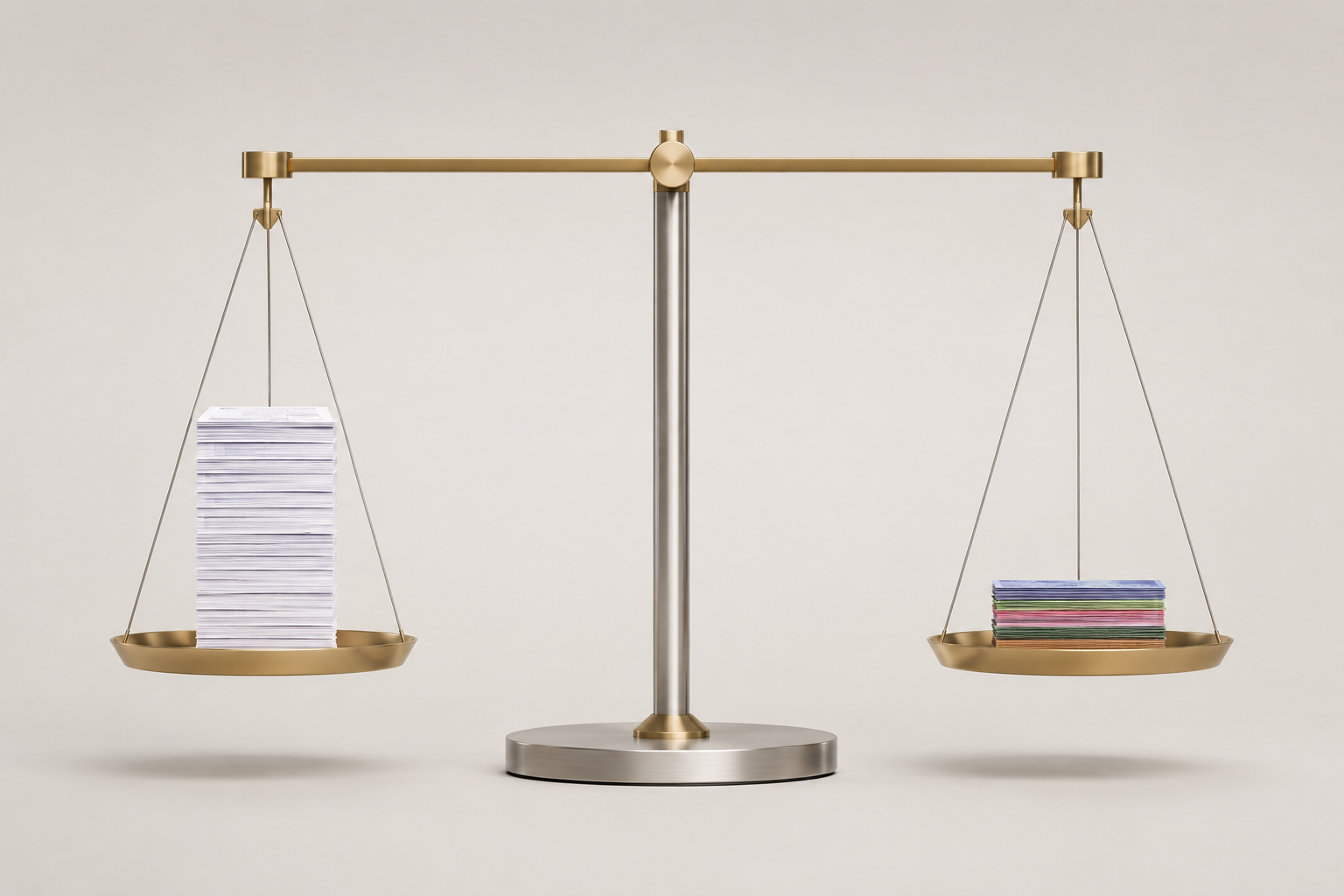
Revenue, profit, cash flow and your bank balance are different things
These numbers are connected, but they don’t tell you the same thing.
Here’s a quick rundown of each:
Revenue is the amount your business earns from selling its services before subtracting expenses.
Profit is what’s left after your business’s expenses are subtracted from its revenue.
Cash flow is the money actually moving into and out of your business.
Your bank balance is the amount sitting in one bank account at a particular moment.
Say you complete $1,000 of work in August and send your client an invoice. You also pay $300 of business expenses, but your client won’t pay until September.
For August, you have $1,000 in revenue and $700 in profit. But because the customer’s payment hasn’t arrived, your cash flow from those transactions is negative $300—and your bank balance is $300 lower.
Nothing is necessarily missing. The numbers are simply measuring different parts of what happened.
That means higher revenue does not automatically produce a higher bank balance. We’re going to trace what can happen between earning the revenue and seeing the cash in your account.
First, check your opening bank balance
To understand why your bank balance changed during the month, start with the amount that was in the account on the first day:
Opening bank balance + cash received − cash paid = ending bank balance
Suppose your business begins the month with $10,000 in the bank. It earns $15,000 in revenue, but only collects $13,000 from customers during the month. Meanwhile, $16,000 leaves the bank. Your ending balance would be $7,000.
$10,000 opening bank balance + $13,000 cash received − $16,000 cash paid = $7,000 ending bank balance
The $15,000 may be more revenue than your business earned last month, but the bank balance still fell by $3,000 because more cash left the account than entered it.
This is why comparing one month’s revenue with today’s bank balance can be misleading. Revenue measures business activity over a period of time. Your bank balance is a snapshot taken on a single date.
You earned the revenue—but you haven’t received the cash
For income-tax reporting, the CRA generally requires business income to be reported using the accrual method. Under this method, revenue is recorded when it is earned, even if your customer hasn’t paid yet.
For example, suppose you complete a $5,000 consulting project and invoice the client on August 28. The $5,000 is included in August’s revenue even if the client does not pay until September.
Until the payment arrives, the $5,000 is recorded as accounts receivable—money a customer owes your business. The invoice has increased your revenue, but it has not increased your bank balance.
So your revenue can increase without that sale adding a single dollar to your bank account.
Your expenses may have increased faster than your revenue
It sucks, but more revenue doesn’t always mean more profit.
Let’s say your revenue increases from $10,000 to $15,000 in July. Awesome! Looks like we had a strong month.
But then you take a closer look at your July expenses and find that they actually increased from $7,000 to $14,000. Boo! Hiss!
Our profit has actually fallen:
| Previous month | Current month | |
|---|---|---|
| Revenue | $10,000 | $15,000 |
| Expenses | $7,000 | $14,000 |
| Profit | $3,000 | $1,000 |
The business recorded $5,000 more in revenue but earned $2,000 less in profit.
Maybe the extra $5,000 in revenue came with a $4,000 contractor bill. And maybe you spent another $3,000 on an advertising campaign to bring in next month’s clients.
Those could both be sensible decisions, but your expenses still increased by $7,000 while your revenue increased by only $5,000.
Remember, higher expenses aren’t necessarily a bad thing. They can be part of growing your business. But when expenses rise faster than revenue, your profit can still fall.
Profit can increase while cash decreases
Sometimes both revenue and profit increase, but the bank balance still falls.
That happens because not every cash payment is a current business expense. Cash can leave the bank without appearing as an expense on this month’s profit and loss statement.
Here are some scenarios where this plays out:
1. You paid bills from an earlier period
Under accrual accounting, an expense can be recorded before it is paid.
Suppose you received a $2,000 contractor invoice in July and paid it in August. The expense may have reduced July’s profit, but the cash didn’t leave the bank until August.
The same thing can happen with a credit card. The card stock you bought for your lettering business may have been recorded as an expense when you bought it.
But cash didn’t leave your bank account until you paid the credit card bill a month later.
Paying the credit card balance later reduces the bank account and the amount owed on the card, but it doesn’t create the expenses again.
This timing difference can make a month profitable while its bank balance still decreases.
2. You bought equipment
Paying for a computer, camera, furniture or other equipment reduces your cash immediately. Take the new computer you finally splurged on—goodbye, frozen Zoom calls!
Capital asset costs are generally recognized over time. Because your new computer will benefit your business for longer than the current month, it will generally be recorded as a capital asset rather than treated as a regular expense all at once.
The full purchase price leaves your bank account when you pay for the computer. But the full amount may not reduce your profit that month.
You can read more about how the CRA distinguishes between recurring current expenses and capital expenses that provide a longer-lasting benefit.
3. You repaid part of a loan
If your business borrows $10,000, its bank balance increases by $10,000—but its revenue increases by $0.
Paying back the loan principal does the reverse: it reduces the bank balance, but it is not an ordinary business expense. It reduces the amount the business owes.
Interest charged on the loan is generally recorded separately as an expense.
Suppose your monthly loan payment is $1,000. Of that amount, $800 goes toward the principal and $200 is interest:
Your bank balance decreases by $1,000.
The amount you owe decreases by $800.
Only the $200 of interest reduces your profit.
So your bank balance falls by $1,000 while your profit falls by only $200.
A large loan payment can therefore reduce cash without causing an equal reduction in profit.
4. You remitted the GST/HST you collected
The GST/HST collected from customers may land in your bank account, but it’s not ordinary sales revenue that the business gets to keep.
For example, if you charge a client $1,130 for a $1,000 taxable service supplied in Ontario:
$1,000 is sales revenue
$130 is HST collected
The tax collected is tracked separately. Depending on the method the business uses, eligible input tax credits may reduce the amount ultimately owed.
When the business pays its net GST/HST owing to the CRA, cash leaves the bank. That payment generally reduces the GST/HST liability rather than creating a new operating expense.
The CRA says GST/HST registrants are responsible for keeping collected GST/HST separate from business operations and remitting the amount owing.
This is one reason the bank balance can look unusually high before a remittance—and fall sharply afterward.
5. You moved money from the business to yourself
Suppose you’re a sole proprietor and transfer $2,000 from your business account to your personal account.
Your bank balance falls by $2,000, but your profit does not change. That’s because an owner’s withdrawal is not a deductible business expense. It reduces the owner’s equity in the business.
Corporations work differently. Salary paid through payroll is an expense of the corporation, while a dividend is not. Any other transfer needs to be recorded according to what it actually represents.
So depending on how the owner is paid, money can leave the business without reducing its profit by the same amount.
Some of the cash may be sitting with your payment processor
A customer payment and a bank deposit are not always the same amount or recorded on the same date.
Say your customer pays a $1,130 invoice through Stripe. For this simplified example, assume Stripe deducts a total processing fee of $33.07:
$1,130 customer payment − $33.07 processing fee = $1,096.93
If no other transactions are included in the payout, $1,096.93 eventually reaches your bank account.
But the books still need to account for:
The full $1,130 customer payment
The $33.07 processing fee
Any GST/HST included in the invoice
The $1,096.93 deposited into the bank
The deposit may also arrive on a later date, include several customer payments or be affected by refunds and other activity. Some money may remain temporarily in your Stripe, PayPal or other processor balance.
So the amount deposited into your bank does not tell you how much revenue you earned. You need the payment-processor activity to explain how the customer’s payment became the bank deposit.
Cash accounting closes one gap—not all of them
Cash accounting closes one timing gap: income is recorded when it is received and expenses when they are paid. But it still doesn’t turn profit into your bank balance.
For income-tax reporting, the CRA limits the cash method to farmers, fishers and self-employed commission agents. Other self-employment income must use the accrual method.
Even on a cash-basis report, equipment purchases, loan principal, GST/HST remittances, owner withdrawals, transfers and payment-processor balances can move cash without becoming revenue or expenses.
So cash-basis profit still won’t necessarily equal the change in your bank balance.
Trace the cash from beginning to end
First, compare the same period.
If you’re reviewing revenue earned from August 1 to August 31, compare it with the cash received and paid during those same dates—and the change between your opening balance on August 1 and your ending balance on August 31.
Don’t compare August’s revenue with the balance showing in your bank halfway through September.
Then work through the records:
Did profit actually increase? Compare the profit and loss statement with the previous month. Expenses may have grown faster than revenue.
Did your customers pay? Check accounts receivable. An increase can mean you recorded more revenue without collecting all the cash.
Did you pay older bills? Check accounts payable and credit card balances. Cash may have gone toward expenses recorded in an earlier month.
Did cash leave without becoming an expense? Look for equipment purchases, loan principal, GST/HST remittances, owner withdrawals and transfers between accounts.
Does every account reconcile? Reconcile the bank, credit cards and payment processors. Every payment, fee, payout and transfer should be recorded once—and only once.
The goal is to explain the change from your opening balance to your ending balance.
Current, complete records show what you earned, what you spent, what customers still owe and what moved outside the profit and loss statement. Revenue alone can’t tell you where the cash went.
Stop guessing where your money went.
Keep your books current with a fixed-price monthly bookkeeping package—month to month, cancel any time before your next billing date.