What does your accountant need from your bookkeeper at year-end?
An unreconciled credit card?
A $2,000 transfer no one can explain?
A GST/HST balance that doesn’t agree with the returns?
None of those problems may be obvious from a tidy profit and loss statement.
That’s why your accountant needs more than financial reports at year-end. They need reconciled books, support for the balances in those reports and a clear record of anything that still needs attention.
Keep reading to find out what a complete year-end bookkeeping package should include.
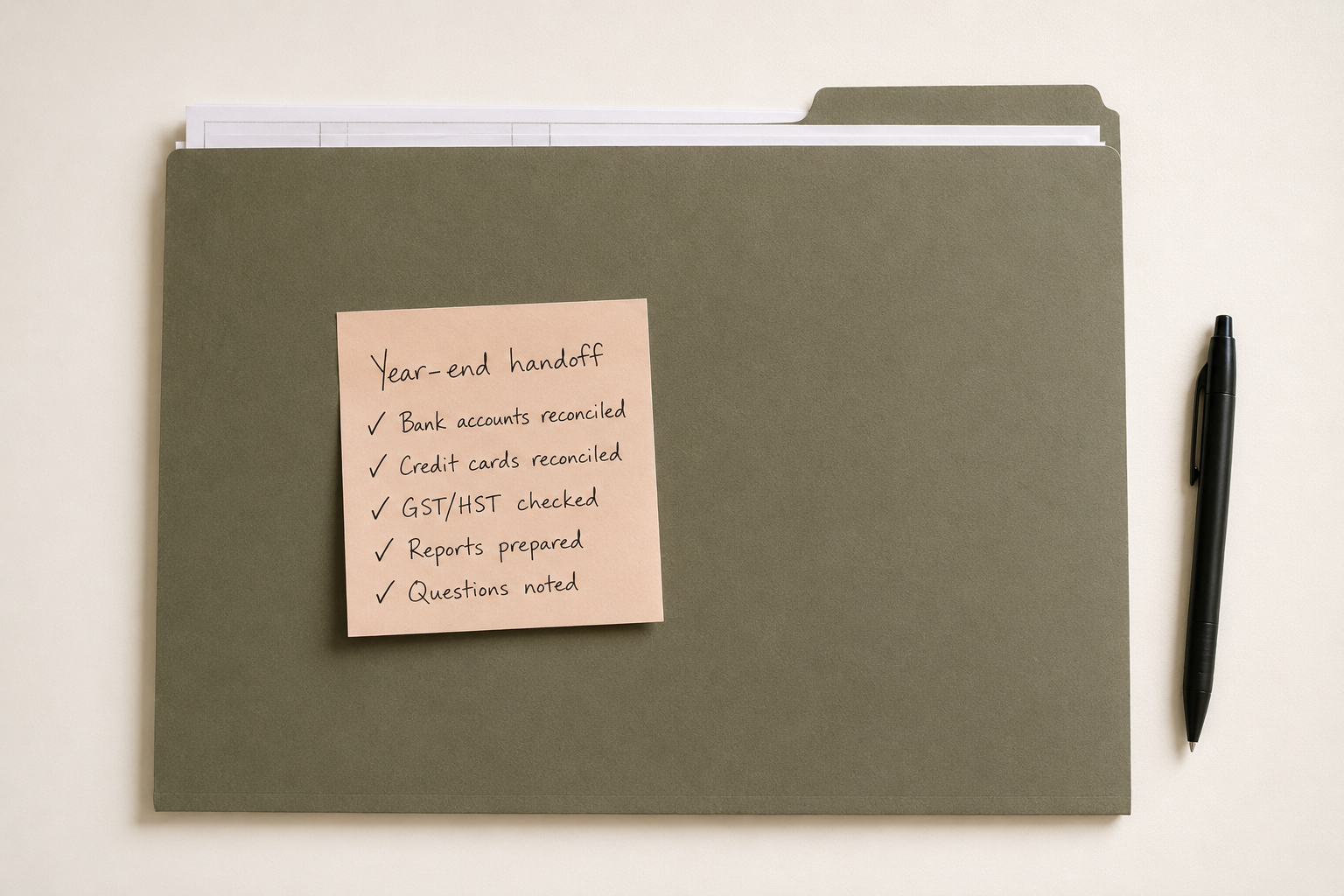
What should be included in a year-end bookkeeping package?
A complete year-end bookkeeping package includes reconciled accounts, core financial reports, supporting schedules and notes about anything that still needs attention.
For a small Canadian service business, it will usually include:
Books reconciled through the final day of the financial year
A trial balance, general ledger, balance sheet and income statement
Supporting details for balances such as GST/HST, accounts receivable, accounts payable, loans and capital assets
Notes about owner transactions, unusual activity and anything that could not be resolved
The exact package will depend on your business. A company with employees may need payroll reports, for example, while a consultant with no employees or outstanding invoices will not.
The goal is to give your accountant organized books with supporting records so they can see what’s already been checked, what the numbers are based on and where they may need to take a closer look.
Your accounts should be reconciled through year-end
Reconciliation means checking the balance in your bookkeeping records against an outside source, like a bank or credit card statement. The records should be able to explain any difference.
Every business bank account and credit card should be reconciled through the final day of the fiscal year. And depending on your type of business, your bookkeeper may also need to reconcile lines of credit, loans, payment processors and clearing accounts.
For example, say your client pays you through Stripe on December 30. But Stripe doesn’t deposit the money into your bank account until January 2. At year-end, that money will not appear in the bank account. Your books should still show that Stripe is holding it.
So your accountant may ask for the year-end statements and, in some cases, a statement from shortly after year-end. This helps them confirm balances and follow transactions that were still in progress when the year ended.
Your accountant needs more than financial statements
Your year-end reports will usually include:
Profit and loss statement: Shows the income the business earned and the expenses it incurred during the year.
Balance sheet: Shows what the business owned and owed on the final day of the year.
Trial balance: Lists the ending balance in every account.
General ledger: Shows the individual transactions behind those balances.
The profit and loss statement and balance sheet give your accountant the big picture. The trial balance and general ledger let them look behind the totals.
For example, the balance sheet may say the business owes $4,000 in GST/HST. The general ledger shows the transactions that produced that number.
The supporting reconciliation, which we’ll discuss next, shows whether it agrees with the business’s GST/HST returns and payments.
Important balances need supporting schedules
Some balances need more explanation than a financial report can provide. For example, a balance sheet might say that your business owes $4,000 in GST/HST. But it will not show your accountant how that number was calculated, which returns have been filed or whether a payment is still on its way to the CRA.
So a supporting schedule fills in those details. Think of it as the work behind the number. Note that not every business will need every schedule below.
1. GST/HST
Suppose the balance sheet for a Toronto product design consultant says the business owes $4,000 in GST/HST at year-end. The most recently filed return may show a different amount. That doesn’t necessarily mean something is wrong. The books might include GST/HST from a more recent period that hasn’t been filed yet. Or the business may have made a payment that hasn’t been recorded by the CRA.
The supporting work should bring together:
GST/HST collected from customers
Input tax credits on eligible business purchases
Returns already filed
Payments made or refunds received
Any return or payment still outstanding
This allows the accountant to see how the balance was calculated and investigate anything that doesn’t add up.
2. Accounts receivable and accounts payable
Let’s say that you, as the Toronto product design consultant, sent your client a $5,650 invoice on December 20. Your client doesn’t pay until January. Under the accrual method, the invoice is still part of your business’s records even though the money isn’t in the bank yet at year-end.
An accounts receivable aging report shows your accountant who owes the money, how much they owe and how long the invoice has been outstanding. An accounts payable aging report does the same for money the business owes to suppliers.
For example, a subcontractor you hired might send an invoice in January for work completed in December. You may need to flag that invoice so the bookkeeper and accountant can determine whether it belongs in the year that just ended. You may also need to explain whether an old customer invoice is still collectible or whether a supplier balance has already been paid.
3. Loans and capital assets
Let’s say you buy a new laptop for $2,260, including HST, shortly before year-end. Your accountant will need more than a transaction categorized as “computer expense.”
The year-end package should identify:
What was purchased
When it was purchased
How much it cost
Whether it was financed
Whether an older computer or other asset was sold or traded in
Your accountant can then determine how the purchase should be treated for tax purposes.
Loans also need support. If your books show a $15,000 loan balance but the lender’s statement shows $16,200, the difference needs to be investigated. A payment may have been divided incorrectly between the amount borrowed, interest and fees.
4. Payroll, if applicable
Let’s say your product design consultancy has one employee. Its year-end payroll records should show that employee’s wages, income tax, Canada Pension Plan contributions, Employment Insurance premiums and other payroll amounts for the year. Those records should agree with the bookkeeping accounts, payroll reports and CRA payroll account.
Timing can create differences here too. The business may owe a December payroll remittance that isn’t due until January. That amount should remain in the books at year-end rather than disappearing because it has not been paid yet. Your accountant may need the year-end payroll summary, remittance records and any T4 slips or T4 Summary that have already been prepared.
Owner transactions and unresolved items should be documented
Oh, if only transactions could explain themselves. A situation like this can arise during bookkeeping: say $2,000 moves from the business bank account to the owner’s personal account. The bank feed shows the transfer, but it doesn’t show why the money moved.
For a sole proprietor, it might be an owner withdrawal. For a corporation, it could be a reimbursement, salary, dividend, shareholder loan transaction or something else. It’s important to remember that those possibilities don’t all receive the same accounting treatment, so your bookkeeper should not guess (actually, your bookkeeper should never guess).
The same problem can happen in reverse. If the owner pays a $339 business software subscription using a personal credit card, the transaction won’t appear in the business bank feed. Now the bookkeeper needs the receipt and an explanation to record it properly.
Owner transactions that may need to be documented include:
Business expenses paid personally
Personal purchases paid from the business account
Money contributed to or withdrawn from the business
Expense reimbursements
Salary or dividends paid by a corporation
Amounts owing to or from a shareholder
There might also be transactions your bookkeeper couldn’t resolve before year-end. This happens and it’s normal. Perhaps an e-transfer has no recognizable name or a receipt is missing or the owner hasn’t yet confirmed whether a purchase was personal or business-related. These items should be gathered into a clear list showing the date, amount, what is known and what information is still needed. That gives the business owner one organized set of questions to answer and shows the accountant which items may still require attention.
Your accountant may still need information from you
A complete year-end package should reduce the number of questions your accountant has, but it may not eliminate them.
Your bookkeeper can organize and explain the information they have received. But they can’t provide a missing receipt, confirm why you moved money or decide whether a customer will ever pay an old invoice without your help.
So your accountant may ask you for:
Bank, credit card or loan statements your accountant wants to review
Receipts and agreements for major or unusual purchases
Customer and supplier invoices from around year-end
Details about expenses you paid personally
Explanations for personal transactions in the business accounts
Confirmation that old customer balances are still collectible
Information about loans, leases or changes in the business
They may also request a statement from shortly after year-end. Continuing with the product design consultancy example, say you were hired for some work by a Calgary-based furniture maker. You invoice them $1,300.
You receive the payment on January 3. The January bank statement helps your accountant trace the payment and confirm that the year-end receivable was collected shortly afterward.
Your accountant might ask you questions about things like this because they need additional information to confirm how an item should be treated or to complete work that falls outside the bookkeeper’s role.
What happens after the year-end package is delivered
Once you hand over the package to your accountant, your accountant reviews the reports, supporting schedules and source documents.
Your accountant might then:
Ask follow-up questions
Request another statement or document
Correct how a transaction was recorded
Record year-end amounts that were not part of the monthly bookkeeping
Prepare the financial statements or tax return included in their engagement
Your accountant may then send back adjusting journal entries. These are entries used to update the bookkeeping records with the accountant’s final year-end adjustments.
For example, your bookkeeper may identify a new computer as a capital asset. Your accountant may later record the appropriate year-end adjustment based on how the asset is treated in the financial statements.
Your bookkeeper should then enter your accountant’s adjustments into the accounting software. This makes the final balances for the old year agree with the opening balances for the new year. Monthly bookkeeping does not necessarily stop while the accountant completes this work. If the next year is already underway, the adjustments can be entered using the appropriate year-end date once they are received.
A smoother year-end actually starts before year-end
If your accountant has to rebuild an entire year from bank statements and unanswered questions, the year-end work can take much longer. It’s more efficient to send over reconciled books, along with the reports behind the numbers, supporting details for important balances and a clear list of anything that still needs attention.
And the easiest way to produce that nice and tidy package is to keep your books current throughout the year.
Why? Because statements can be collected as they arrive, unusual transactions can be explained while they are still fresh in mind and problems can be dealt with before they turn into year-end surprises.
Become your accountant’s favourite client this year.
Keep your books current with a fixed-price monthly bookkeeping package—month to month, cancel any time before your next billing date.